TL;DR
-
AI content absolutely can rank on Google. An Ahrefs study of 600,000 pages found the correlation between AI content percentage and ranking position is 0.011 - statistically nothing. But a Semrush analysis of 42,000 blog posts found human-written content is 8x more likely to occupy the #1 spot. Both findings are true. They’re not contradictory.
-
The real threat to your rankings isn’t an AI detector. It’s that AI tools produce content that remixes what already exists. Google’s March 2026 core update deployed a Gemini 4.0 semantic filter that specifically targets content with zero Information Gain - pages that add nothing new to the conversation. This is now arguably the most consequential ranking signal in search.
-
A 16-month study tracking 4,200 articles found pure AI content ranked 23% lower on average, acquired 61% fewer editorial backlinks, and was deindexed at 3.2x the rate of human-written content. But AI-assisted content with substantive human editing closed the gap to just 4%. The variable that matters isn’t whether AI touched the draft. It’s editorial investment.
-
94% of marketers plan to use AI for content creation in 2026 (HubSpot). The question isn’t whether to use AI. It’s how to use it without producing the kind of content Google’s systems have been trained to ignore.
You’ve been asking the wrong question.
Every marketer I talk to asks some version of “can I use AI content for SEO?” I understand the anxiety. Post the wrong content and your rankings disappear. But the question itself is broken. It’s like asking “can I use a camera to make a good film?” The camera isn’t the variable. What you point it at is.
Google’s official guidance has held steady since 2023. Appropriate use of AI is not against their guidelines. What is against their guidelines is using AI to mass-produce pages that add no value - what they call “scaled content abuse” in their spam policies. Those two things are completely different problems.
In May 2026, Google published its first official AI Optimization Guide. It’s a short document that says something telling: optimizing for AI search is still SEO. The fundamentals haven’t changed. Quality, authority, and originality still determine everything.
So let’s bury the wrong question and build the right framework. By the end of this article, you’ll have a test you can run on every piece of content before it goes live - regardless of whether AI touched it.
What Five Major Studies Actually Found About AI Content and Rankings (2025–2026)
The landscape has shifted dramatically since late 2025. Here’s what the latest data says:
| Study | Sample Size | Key Finding | Date |
|---|---|---|---|
| Ahrefs | 600,000 pages | AI-to-ranking correlation: 0.011 (zero). 86.5% of top pages contain some AI. Only 4.6% are pure AI. | July 2025 |
| Semrush | 42,000 blog posts | Human content 8x more likely at position #1 (80.5% vs 9.8%). Gap narrows by position 5. | April 2026 |
| Originality.ai | 500 keywords (ongoing) | AI in top 20 results: 17.31% (Sept 2025), up from 2.27% in 2019. Peaked at 19.56% (July 2025). | Ongoing |
| Digital Applied | 4,200 articles, 140 domains | Pure AI ranked 23% lower. Deindexation 3.2x higher. AI-assisted within 4% of human. | March 2026 |
| Ahrefs (new pages) | 900,000 new pages | 74% of all new web content contains AI-generated text. | May 2025 |
Here’s what this means in practice, not in the abstract.
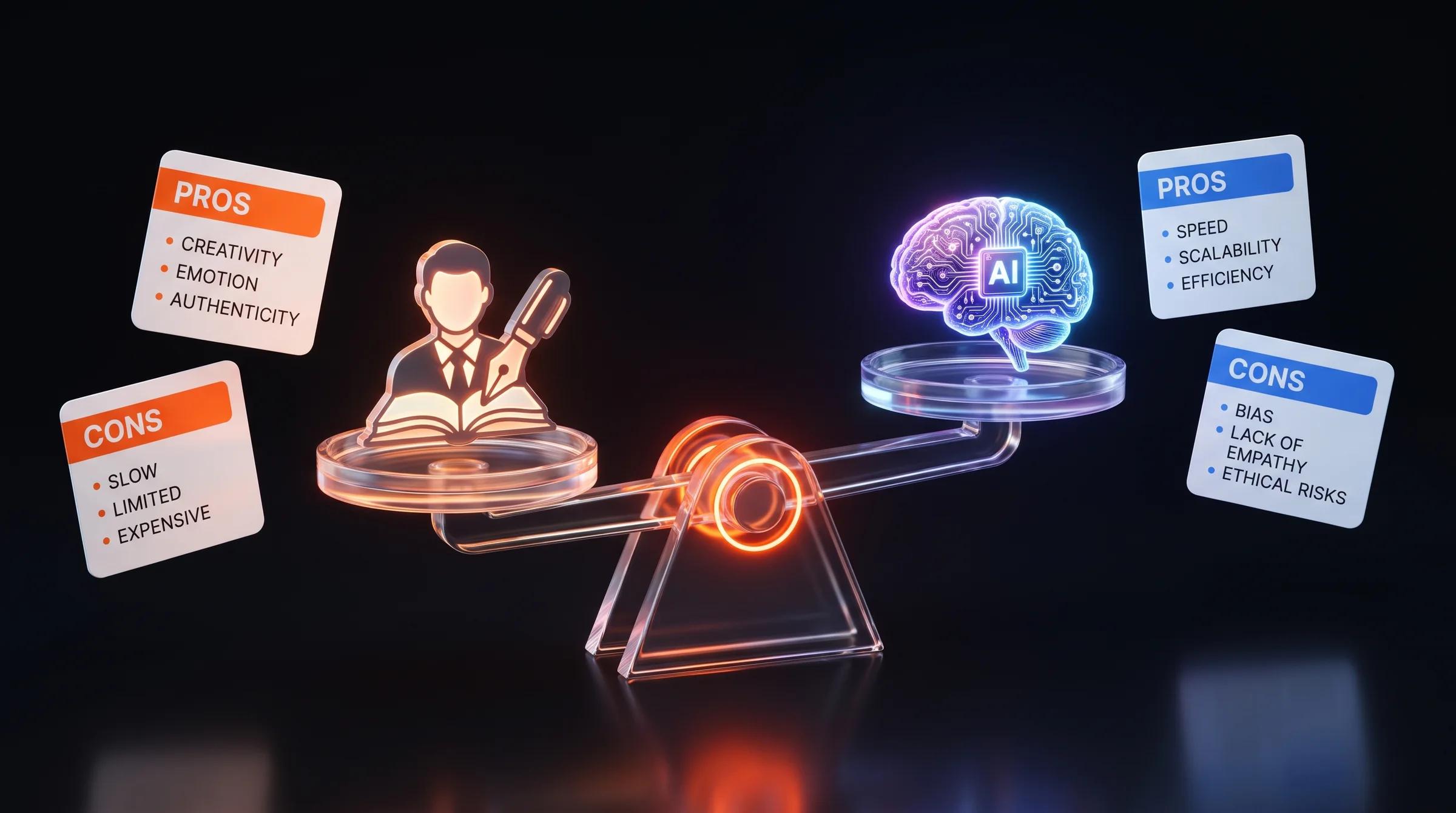
Ahrefs proved Google doesn’t punish content for being AI-generated. If it did, more AI would mean lower rankings - that pattern doesn’t exist. But pure AI content makes up just 4.6% of top-ranking pages. The 81.9% majority of top pages blend human and AI. The world isn’t choosing between AI and human. It’s choosing how much editorial effort to layer on top.
Semrush revealed the position #1 reality: human content appears there 80.5% of the time, pure AI just 9.8%. But from position 5 downward, the gap narrows. AI holds its own on page one. It just doesn’t own the top.
Digital Applied measured something nobody else did: time. At 3 months, pure AI trailed human content by 14%. At 16 months? 31%. Human content accumulates links and authority. AI-only content plateaus, then declines.
“AI helps us move faster, and speed does matter. But not enough to justify lowering quality standards. In most cases, an extra day or two won’t change the outcome - quality will.”
- Ana Camarena, Head of Organic Content Strategy at Semrush (Source)
Why Most AI Content Fails (It’s Not About Detection)
AI detection tools are inconsistent. The best cap at 82% accuracy, and false positives range from 3% to 15% (Digital Applied). Google isn’t outsourcing ranking decisions to a detector that thinks the U.S. Constitution was written by ChatGPT.
The real problem is Information Gain.
Information Gain measures how much new, non-redundant information a page contributes compared to what’s already indexed. Google patented this concept years ago. The March 2026 core update made it operational - the first core update powered by Gemini 4.0’s semantic understanding. It didn’t ban AI content. It filtered content that adds nothing the index didn’t already have.
Think of it like a classroom. Raise your hand and repeat what three other students already said. The teacher stops calling on you.
AI tools are remixing machines. Ask ChatGPT to write about “email marketing best practices” and you’ll get a competent synthesis of everything that already exists. Useful for some tasks. For ranking on a competitive keyword? It’s photocopying your competitor’s content.
Google’s January 2025 Search Quality Rater Guidelines made the stakes explicit: if all or almost all of a page’s content is AI-generated with little originality added, raters must apply the Lowest quality rating. Content that is “copied, paraphrased, embedded, auto or AI generated… with little to no effort, little to no originality, and little to no added value” earns the floor. Quality rater feedback shapes how Google tunes its algorithms.
The Digital Applied study quantified the impact post-March 2026: human content gained 11%. AI-assisted gained 4%. Pure AI dropped 18%. Sites running scaled AI publishing lost hundreds or thousands of pages simultaneously.
The Four Tiers of AI Content (They Don’t All Perform the Same)
This is the part both the “AI is fine” and “AI is spam” crowds get wrong. There isn’t one category called “AI content.” There are four meaningfully different approaches. They perform very differently in search.
| Tier | Description | SEO Performance | Post-March 2026 Update |
|---|---|---|---|
| Tier 1: Pure AI | Prompt in, publish out. Light copyediting only. | Weakest. 23% lower average ranking vs human content. 3.2x deindexation risk. | -18% ranking decline |
| Tier 2: AI-Drafted, Human-Polished | AI writes draft; human edits for voice, adds examples, fixes errors. | Moderate. Works for low-competition topics. Information Gain still often low. | Widely variable |
| Tier 3: Human-Led, AI-Assisted | Human researches, outlines, writes core. AI helps with structure, readability, headlines. (64% of SEO teams use this model.) | Strong. Within 4% of pure human content on median ranking. | +4% ranking improvement |
| Tier 4: AI as Insight Accelerator | Human gathers original data, experiences, expert interviews. AI formats and structures raw insights. | Strongest. High Information Gain. Citeable by AI engines. | +11% ranking improvement |
The pattern is consistent across every major study. AI isn’t the variable. Editorial investment is. A skilled editor can transform an AI draft into competitive content in roughly 90 minutes for a 1,500-word article, versus 4–6 hours to write from scratch. The workflow economics make sense. What doesn’t make sense is stopping at the AI draft.
How to Make AI Content That Actually Ranks in 2026
The data points to five things that actually work:
-
Collect something AI can’t have before you prompt anything. Your own test results. A client outcome with real numbers. Three expert conversations. Internal data nobody else has. The Digital Applied study found only 4% of pure AI articles included original data or proprietary research. Among human-written content, that was 38%. AI can help you shape and present raw material. It can’t generate it.
-
Use AI for structural work, not insight work. AI is genuinely good at suggesting H2 structures, checking whether your outline covers search intent, improving sentence clarity, cutting filler, and generating realistic FAQ questions. 70% of SEO teams say speed is AI’s top benefit. Only 19% say it improves quality (Semrush). Use AI where it’s actually effective.
-
Run every draft through the Information Gain Test. Pull the top five results for your target keyword. Read them. Now read your draft. If a reader who’d already consumed those five articles would learn nothing new from yours, you have a problem. One genuinely new data point, observation, or reframe is enough. Zero is disqualifying. [INTERNAL LINK: information gain seo framework]
-
Build E-E-A-T signals that AI can’t fake. 89% of pure AI articles had no bylined author with verifiable credentials. 94% had no expert quotes. Only 2% included first-person experience narratives. Among human content, 71% had bylined experts, 52% had expert quotes, and 67% had a clear opinionated perspective. These signals aren’t decorative. They’re measurable ranking factors post-March 2026. [INTERNAL LINK: eeat content strategy guide]
-
Structure content for AI answer engines. Google AI Overviews appear in roughly 55% of searches (Heroic Rankings). ChatGPT, Perplexity, and AI Mode increasingly determine whether your content gets cited. These systems favor content structured for extraction: clear definitions, specific claims with attributable sources, self-contained paragraphs, and direct answers near the top of each section. 88% of AI Overviews cite three or more sources. Your content needs to be the most citable option. [INTERNAL LINK: answer engine optimization guide]
Reality check: AI content won’t tank your rankings by default. But pure AI content also won’t beat content written by someone who actually knows the subject. Those are different claims. Most of the articles you’re competing against in any valuable SERP are written by humans with real expertise. If your AI content can’t match that depth, the low penalty threshold becomes irrelevant. You’ll lose on merit, not on detection.
The Backlink Problem Nobody Talks About
Pure AI content acquired 61% fewer editorial backlinks than human-written content on equivalent topics, per the Digital Applied study. Publishers link to content that gives them something to cite - original data, a unique perspective, a case study. Synthesis-only content doesn’t earn links, even when accurate. This compounds: fewer links means lower rankings, which means less visibility, which means fewer organic link discoveries. The 3-month gap of 14% widens to 31% at 16 months largely because of this.
What Happens If You Get This Wrong
Originality.ai’s study of Google’s March 2024 manual actions found 100% of penalized websites used AI, and half had 90–100% AI posts. The common thread wasn’t AI. It was zero original value.
Google’s May 2026 core update is rolling out now. Early reports describe a crackdown on scaled AI content and “AI blog” subfolders. Sites publishing high volumes of pure AI content are seeing collapses. Sites with original, expert-led content are gaining. The pattern across every update since 2023 is the same: low-quality loses, high-quality wins. Origin is irrelevant.
Frequently Asked Questions About AI Content and SEO
Does Google penalize AI-generated content in 2026?
No. Google’s guidance is clear: appropriate AI use is fine. What Google penalizes is “scaled content abuse” - mass-producing pages that add no value. The March 2026 core update introduced a Gemini 4.0 semantic filter targeting content without Information Gain. The tool isn’t the problem. The output is.
Is human content still better than AI content for rankings?
Pure AI content ranks 23% lower and is 8x less likely to reach position #1 (Semrush). But AI-assisted content with substantive human editing performs within 4% of fully human-written content (Digital Applied). The gap is editorial, not technological.
What percentage of Google search results contain AI content?
Originality.ai’s study found 17.31% of the top 20 results contain AI-generated content (Sept 2025), up from 2.27% in 2019. Ahrefs found 86.5% of top-ranking pages contain at least some AI. The question isn’t whether AI is in search - it’s how much editorial work accompanies it.
What is scaled content abuse?
Google’s spam policy term for mass-producing pages with automation primarily to manipulate rankings. It applies to both AI and human content. Penalized sites are deindexed at 3.2x the normal rate (Digital Applied). The threshold isn’t page count - it’s the ratio of volume to value.
Can AI content appear in Google AI Overviews?
Rarely when it’s purely AI-generated. AI answer engines prefer sources with Information Gain - specific claims, attributable data, content that adds something the other indexed sources don’t have. Generic AI content gives them nothing new to cite. [INTERNAL LINK: ai overviews optimization strategy]
If you want help building a content operation that runs this framework at scale - original insight collection, AI-assisted production, and an editorial layer that enforces Information Gain standards before anything publishes - LoudScale works with teams doing exactly that.
Sources
- Ahrefs - AI-Generated Content Does Not Hurt Your Google Rankings (600K Pages)
- Semrush - Does AI Content Rank Well? (42K Blog Posts, Survey + Data Study)
- Originality.ai - AI Content in Google Search Results (Ongoing Study)
- Digital Applied - AI vs Human Content: 16-Month Google Ranking Study
- Search Engine Land - Human Content 8x More Likely to Rank #1
- Google - AI-Generated Content Guidance
- Google - AI Optimization Guide (May 2026)
- Digital Applied - Information Gain: Google’s #1 Ranking Signal in 2026

LoudScale Team
Growth Marketing Specialists
The LoudScale team shares practical strategies and experiments across search and AI visibility, content authority, account-based demand, lifecycle systems, analytics, and responsible AI.